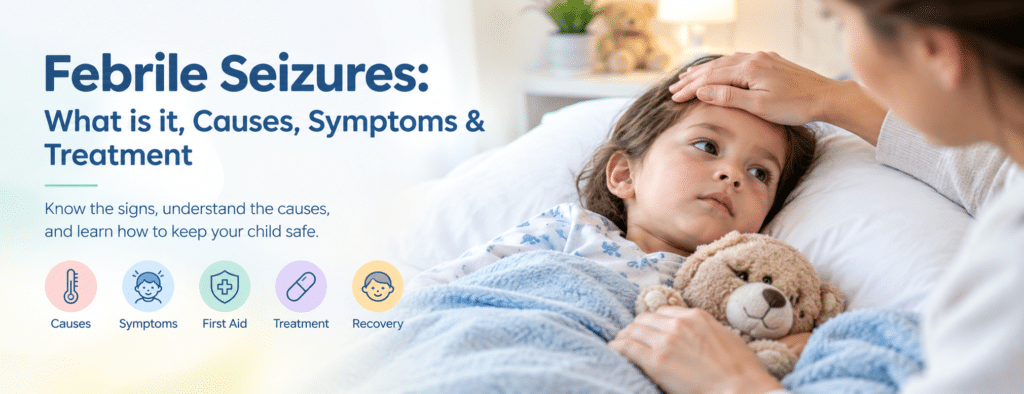
Seeing your child suddenly stiffen, shake, or become unresponsive during a fever can be extremely frightening. Febrile seizures are seizures associated with fever, most commonly affecting young children between about 6 months and 5–6 years of age. Although they can look serious, most are brief and do not cause lasting brain damage or mean that a child has epilepsy.
Understanding the signs, causes, first-aid steps, and treatment can help parents respond calmly and seek medical care when necessary.
What Are Febrile Seizures?
A febrile seizure is a seizure triggered by fever in a young child who does not have another known cause for the seizure. It may occur during an infection and can sometimes happen before parents realize that their child has a fever.
Febrile seizures are generally divided into:
- Simple febrile seizures: Usually involve the whole body, last less than 15 minutes, and occur only once during a 24-hour period.
- Complex febrile seizures: May last longer, affect only part of the body, or happen more than once within 24 hours.
Most children recover completely after a simple febrile seizure.
What Causes Febrile Seizures in Children?
The exact reason some children develop seizures with fever is not completely understood. A child’s developing nervous system may be more sensitive to a rapid change in body temperature.
Common triggers include illnesses that cause fever, such as:
- Viral infections, including colds and flu
- Ear infections
- Throat or tonsil infections
- Respiratory infections
- Other bacterial or viral infections
Family history may also play a role, as febrile seizures can occur more frequently in children with relatives who experienced them.
Importantly, the severity of the fever does not always predict whether a seizure will occur. Febrile seizures can sometimes happen with a relatively mild fever.
Symptoms of Febrile Seizures
During a febrile seizure, parents may notice sudden and unusual movements or changes in consciousness.
Common Symptoms
A child may:
- Suddenly become stiff
- Have rhythmic jerking or shaking of the arms and legs
- Lose consciousness or become unresponsive
- Roll their eyes upward
- Have temporary changes in breathing or skin colour
- Wet or soil themselves
- Become sleepy, confused, or irritable after the seizure
Most febrile seizures stop within a few minutes. A child may remain drowsy for a short period afterward while recovering.
What Should Parents Do During a Febrile Seizure?
If your child has a seizure, try to remain calm and focus on preventing injury.
Do:
- Place the child somewhere safe, away from hard or sharp objects.
- Note the exact time the seizure begins.
- Protect the child’s head with something soft.
- Once the seizure stops, place the child on their side to help maintain a clear airway.
- Seek medical advice, particularly if it is the child’s first seizure.
Do not:
- Hold or restrain the child.
- Put fingers, food, medicine, or objects into their mouth.
- Try to force the child’s mouth open.
- Use cold water or other methods to rapidly cool the child during the seizure.
When Is Emergency Care Needed?
Seek emergency medical help if the seizure lasts longer than 5 minutes, the child has difficulty breathing, the seizure affects only one side of the body, another seizure occurs within 24 hours, or the child does not recover normally afterward. A first seizure should also be medically assessed.
Treatment for Febrile Seizures
Treatment mainly focuses on identifying and treating the cause of the fever. After a first febrile seizure, a pediatrician may examine the child and determine whether tests are necessary to identify an underlying infection.
Most simple febrile seizures do not require long-term anti-seizure medication. In selected cases involving prolonged or repeated seizures, a doctor may prescribe emergency medication and provide parents with a seizure action plan.
Fever medicines such as paracetamol or ibuprofen may help improve a child’s comfort, but they do not reliably prevent future febrile seizures. Parents should use medicines only according to appropriate pediatric dosing advice.
Do Febrile Seizures Mean Epilepsy?
No. Febrile seizures are different from epilepsy. Most children who experience simple febrile seizures do not develop epilepsy and grow out of febrile seizures as they get older. There is, however, a small increased risk of epilepsy in some children, which is one reason appropriate medical assessment is important.
Frequently Asked Questions About Febrile Seizures
1. Are febrile seizures dangerous?
Most are brief and do not cause permanent brain or nervous-system damage. However, prolonged seizures require urgent medical treatment.
2. At what age do febrile seizures usually occur?
They are most common in young children, particularly between approximately 6 months and 5–6 years of age.
3. Can febrile seizures happen again?
Yes. Some children experience another febrile seizure during a later illness, particularly when certain risk factors are present.
4. Can fever medicine prevent febrile seizures?
Fever-reducing medicines can make a child more comfortable but do not reliably prevent febrile seizures.
5. When should I contact a pediatrician?
A child should be medically assessed after a first seizure. Emergency care is especially important when a seizure lasts more than 5 minutes, breathing is affected, seizures repeat, or recovery is unusual.
Conclusion
Febrile seizures can be alarming, but most are short-lived and children recover fully. Knowing what a seizure looks like, keeping your child safe during an episode, and recognizing when emergency medical attention is needed can make a difficult situation easier to manage.
If your child has experienced a seizure with fever or you are concerned about recurring episodes, speak with a qualified pediatrician for an appropriate evaluation and personalized guidance.
For expert pediatric evaluation and child-focused medical care, consult CLIO Mother and Child Institute Hospital.


Proudly powered by CLIO Mother and Child Institute