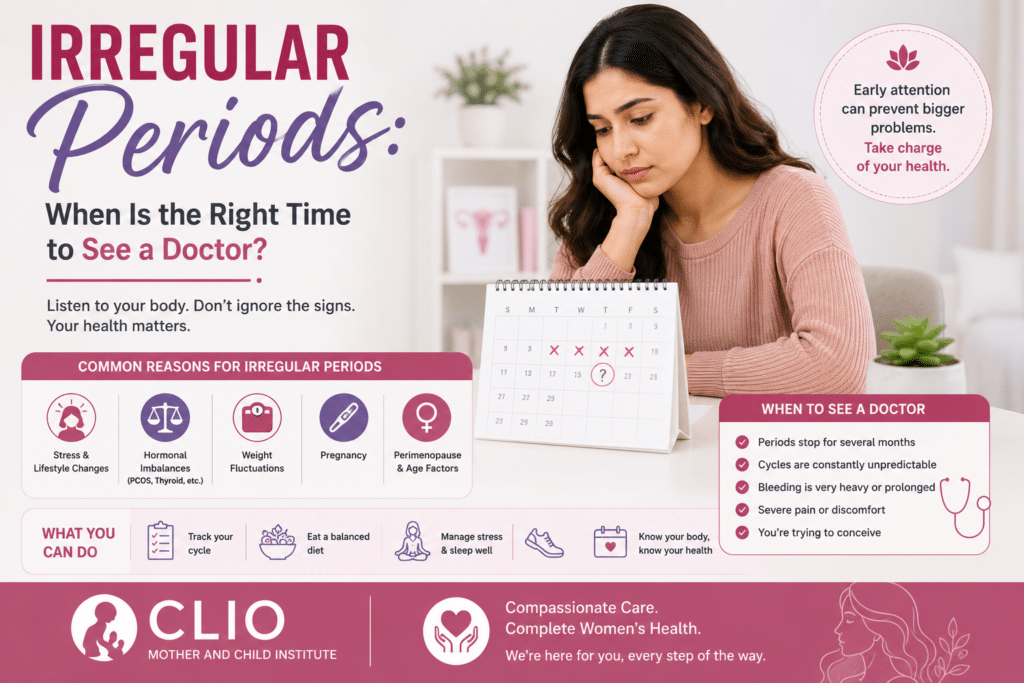
For many women, periods are rarely perfectly predictable. One month arrives early, another comes late, and sometimes it skips altogether. Life gets busy, stress creeps in, routines change—and it’s easy to brush it off.
But at some point, a question naturally appears: Is this normal, or should I see a doctor?
The truth is, occasional changes in your menstrual cycle are common. Persistent irregularity, however, is worth paying attention to.
At CLIO Mother and Child Institute, irregular periods are one of the most common concerns women discuss—especially when they begin affecting fertility, daily life, or overall health.
What Counts as an Irregular Period?
A “normal” menstrual cycle isn’t exactly the same for everyone.
For many women, periods occur every 21 to 35 days. But irregular periods may look like:
- Missing periods completely
- Cycles that constantly change length
- Very heavy bleeding
- Extremely light periods
- Bleeding between periods
The occasional off month usually isn’t alarming. A recurring pattern is different.
Why Do Periods Become Irregular?
Your menstrual cycle is closely tied to hormones. When hormone balance shifts, periods often change too.
Sometimes the cause is temporary. Other times, it signals something that deserves medical attention.
1. Stress and Lifestyle Changes
Your body notices stress—even when you try to ignore it.
Emotional stress, poor sleep, sudden weight changes, or excessive exercise can disrupt hormones and delay ovulation.
Sometimes your cycle returns to normal once routines stabilize.
2. Hormonal Conditions
Hormonal imbalances are one of the biggest reasons periods become irregular.
Conditions like Polycystic Ovary Syndrome often lead to unpredictable cycles because ovulation becomes irregular.
Thyroid issues can also affect menstrual patterns.
3. Weight Fluctuations
Significant weight gain or weight loss may influence estrogen levels, affecting the menstrual cycle.
Your body likes consistency more than extremes.
4. Pregnancy
Sometimes a missed period is exactly what you think it might be.
If periods suddenly stop and pregnancy is possible, testing is worth considering.
5. Perimenopause
As women approach menopause, cycles may naturally become less predictable.
Though age-related changes are normal, it’s still important to rule out other causes if symptoms seem unusual.
When Is the Right Time to See a Doctor?
This is usually the real question.
Not every irregular cycle needs urgent attention—but some situations shouldn’t be ignored.
Consider seeing a doctor if:
Your Periods Stop for Several Months
If periods disappear without explanation, it’s time to investigate.
Cycles Are Constantly Unpredictable
A random irregular month happens. Ongoing inconsistency deserves a closer look.
Bleeding Becomes Very Heavy
Changing pads excessively, large clots, or prolonged bleeding should not be ignored.
Severe Pain Appears
Mild cramps are common. Intense pain that interferes with daily life is not something to simply “live with.”
You’re Trying to Conceive
Irregular ovulation can affect fertility. Early evaluation often helps avoid delays.
At CLIO Mother and Child Institute, women often seek help after months of waiting for things to “settle naturally.” Sometimes reassurance is all that’s needed. Other times, early intervention makes a meaningful difference.
Don’t Ignore Small Changes
Many women normalize symptoms for too long.
“It’s probably stress.”
“It’ll fix itself next month.”
“Maybe this is just how my body works.”
Sometimes that’s true.
But when changes become persistent, your body may be trying to tell you something.
Irregular periods aren’t always serious—but they’re information.
What to Expect at the Doctor’s Visit
If you decide to seek medical advice, the process is usually straightforward.
Doctors may ask about:
- Cycle history
- Stress levels and lifestyle
- Weight changes
- Symptoms like acne or hair growth
- Pregnancy history or fertility concerns
Sometimes blood tests or ultrasound scans are recommended to understand what’s happening hormonally.
The goal isn’t to complicate things—it’s to get clarity.
Can Irregular Periods Be Treated?
In many cases, yes.
Treatment depends on the cause.
Sometimes lifestyle changes help. Sometimes hormonal support or medications are recommended. And sometimes, no treatment is needed at all—just monitoring.
The important thing is knowing why it’s happening.
Final Thoughts
Periods don’t need to be perfectly predictable to be normal. But consistently irregular cycles deserve attention.
The right time to see a doctor is usually sooner than most people think—not because something serious is always wrong, but because understanding your body matters.
At CLIO Mother and Child Institute, the focus is simple: listen to what your body is saying, ask questions early, and get answers that help you move forward with confidence.
Because sometimes, the smallest symptom is the one worth noticing.


Proudly powered by CLIO Mother and Child Institute