Pregnancy comes with many decisions, but few feel as important as the one surrounding delivery. Somewhere in the final months, the question naturally appears: Will it be a normal delivery or a C-section?
For many mothers, this becomes a source of anxiety. There’s advice from relatives, stories from friends, and an overwhelming amount of information online. But the truth is simpler than it seems—both normal delivery and cesarean section are safe ways to bring a baby into the world. The right choice depends on the health of the mother, the baby, and the circumstances of the pregnancy.
At CLIO Mother and Child Institute, the focus is never on pushing one option over the other. It’s about choosing the safest path for both mother and child.
What Is a Normal Delivery?
A normal delivery, also called vaginal delivery, happens when the baby is born naturally through the birth canal. Labour begins on its own or is medically induced, and the body gradually prepares for childbirth.
For many women, this is the preferred option because it usually involves a shorter hospital stay and quicker recovery.
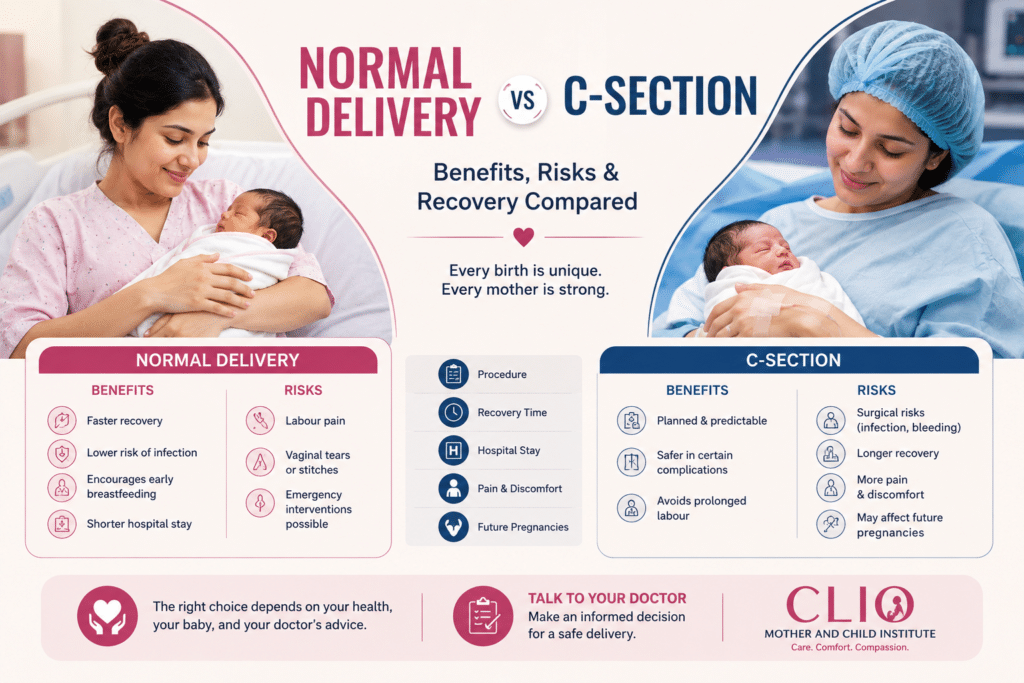
Benefits of Normal Delivery
Faster Recovery
Most mothers recover more quickly after a vaginal birth. Walking, moving, and returning to daily activities often becomes easier within a shorter time.
Lower Surgical Risks
Since there’s no major surgery involved, risks related to infection, anesthesia, and surgical complications are generally lower.
Earlier Bonding and Breastfeeding
Many mothers find it easier to begin breastfeeding and bonding soon after delivery.
Shorter Hospital Stay
Recovery tends to be smoother, which often means going home earlier.
Risks of Normal Delivery
Despite its advantages, normal delivery can still involve challenges.
- Labour can be long and physically exhausting
- Vaginal tears or stitches may occur
- Emergency interventions may become necessary if complications arise during labour
Every labour experience is different. Some progress smoothly, while others require medical assistance.
What Is a C-Section?
A cesarean section (C-section) is a surgical procedure used to deliver the baby through incisions made in the abdomen and uterus.
Sometimes it’s planned in advance. Other times, it becomes necessary during labour if complications develop.
When Is a C-Section Recommended?
Doctors may advise a C-section if:
- The baby is in an unusual position
- Labour isn’t progressing normally
- There are concerns about the baby’s heart rate
- The mother has certain medical conditions
- There’s a high-risk pregnancy or multiple babies
In these situations, a C-section can be the safest option.
Benefits of a C-Section
Planned and Predictable
Scheduled C-sections allow better preparation and reduce uncertainty around labour timing.
Safer in Certain Complications
When medical risks are involved, a C-section can prevent serious complications for mother and baby.
Avoids Prolonged Labour
In difficult labour situations, surgery may reduce stress on both the baby and the mother.
Risks of a C-Section
Because it’s a major surgery, recovery usually takes longer.
Possible challenges include:
- Increased pain after delivery
- Longer hospital stay
- Higher risk of infection
- Delayed physical recovery
Future pregnancies may also need additional monitoring after a previous cesarean delivery.
Recovery: What’s the Difference?
This is often where the biggest contrast appears.
Recovery After Normal Delivery
Most mothers begin moving around within hours. Discomfort is usually manageable, though soreness and fatigue are common.
Recovery After C-Section
Recovery tends to be slower because the body is healing from surgery. Simple movements like standing, walking, or lifting may feel difficult for a few days.
That said, many women recover well after a C-section with proper rest and care.
At CLIO Mother and Child Institute, postnatal care focuses on helping mothers recover comfortably regardless of the delivery method.
There’s No “Better” Birth
One of the biggest misconceptions is that one type of delivery is somehow more “successful” than the other.
It isn’t.
A safe delivery is what matters most. Sometimes that happens naturally. Sometimes it requires surgery. Neither choice defines motherhood.
The healthiest approach is staying informed while remaining flexible. Birth doesn’t always follow a plan.
How Doctors Decide
The decision isn’t usually made based on preference alone. Doctors consider:
- Mother’s health
- Baby’s position and condition
- Pregnancy complications
- Labour progression
What matters is choosing the option that reduces risk and supports a healthy outcome.
Final Thoughts
Normal delivery and C-section are not competing paths—they’re medical approaches designed for different situations.
If your pregnancy is low-risk, a normal delivery may be possible and beneficial. But if complications arise, a C-section can be life-saving.
At CLIO Mother and Child Institute, the goal is simple: provide safe, compassionate care while helping mothers feel informed instead of pressured.
Because in the end, the method of birth matters far less than the well-being of the mother and baby who come through it together.


Proudly powered by CLIO Mother and Child Institute