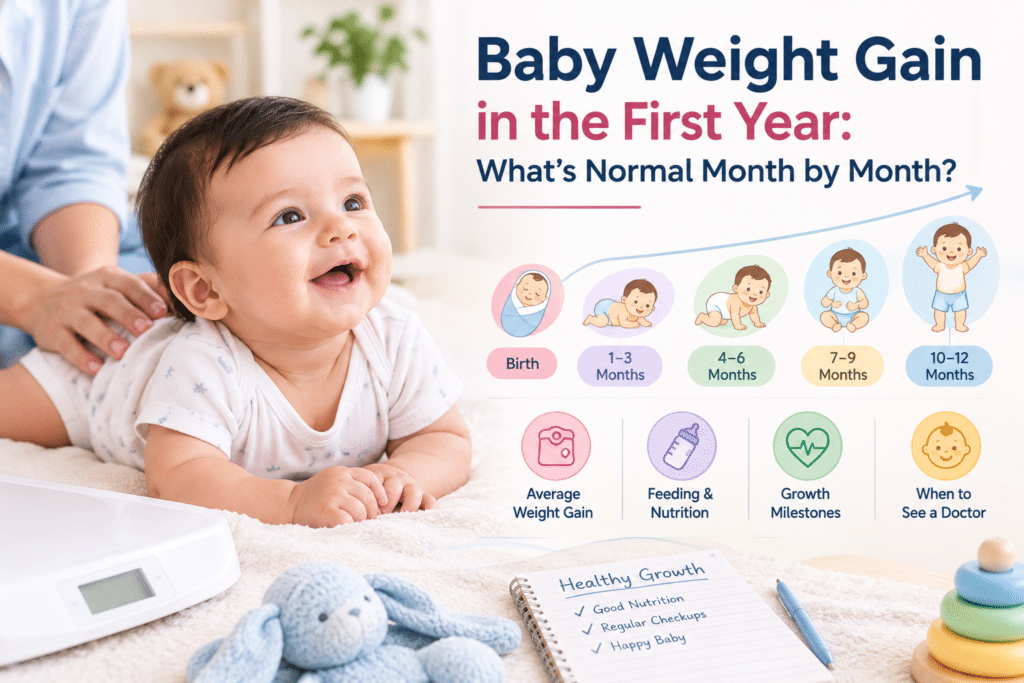
Watching your baby grow is exciting—and sometimes a little confusing. One month your baby seems to be gaining weight quickly, while the next month the changes may seem much smaller. So, what is normal?
Baby weight gain in the first year varies from child to child. Birth weight, feeding, genetics, health, and overall development can all influence growth. Instead of focusing on one number, pediatricians look at your baby’s growth pattern over time using age- and sex-specific growth charts. The WHO provides weight-for-age and weight-velocity standards from birth through early childhood.
Baby Weight Gain: What Happens Month by Month?
Birth to 1 Month
It is normal for newborns to lose some weight during the first few days after birth as excess fluid leaves their body. Most babies begin gaining steadily afterward and usually return to their birth weight within the first few weeks.
During this stage, doctors also look at feeding, wet diapers, alertness, and overall health—not just the number on the weighing scale.
1 to 2 Months
Weight gain is usually rapid during these early months. Many babies gain around 1.5–2 pounds (0.7–0.9 kg) per month between 1 and 4 months, although individual growth can vary.
Breast milk or infant formula remains the primary source of nutrition.
2 to 3 Months
Your baby’s appetite and feeding patterns may change as they grow. Consistent weight gain, increasing length, and continued development are generally reassuring signs.
Your pediatrician may plot your baby’s measurements on a growth chart to see whether they are following their expected growth pattern.
3 to 4 Months
Growth generally continues at a strong pace. Some babies may experience temporary growth spurts, while others gain more gradually.
Around this period, many babies are approaching an important milestone: some may double their birth weight at about 4–6 months, although the exact timing varies.
5 to 6 Months
By around six months, many babies have approximately doubled their birth weight. However, this is a general milestone—not a deadline.
Growth begins to slow gradually compared with the first few months. If complementary foods are introduced around six months, breast milk or formula continues to provide important nutrition.
7 to 8 Months
Baby weight gain often becomes more gradual as babies become increasingly active. Crawling, rolling, sitting, reaching, and other movements increase energy expenditure.
Rather than comparing your baby with another child, focus on whether your baby is continuing along their own growth curve.
9 to 10 Months
At this age, babies may be very active. Their weight may not increase as quickly as it did during early infancy.
A healthy growth pattern considers weight, length, and development together. WHO growth standards can help healthcare professionals assess weight-for-age and weight-for-length.
11 to 12 Months
By the first birthday, many babies have roughly tripled their birth weight, but there is considerable normal variation. Growth naturally slows toward the end of the first year.
The important question is not whether your baby matches an average number, but whether their growth remains appropriate for them.
What Can Affect Baby Weight Gain?
Several factors can influence infant growth, including:
- Breastfeeding, formula feeding, or combination feeding
- Birth weight and gestational age
- Genetics and family growth patterns
- Feeding difficulties
- Illness or infections
- Digestive or absorption problems
- Activity level
- Introduction of complementary foods
- Prematurity
There is no single “perfect” baby weight. A baby’s growth percentile should be interpreted alongside their previous measurements and overall health.
When Should Parents Talk to a Pediatrician?
Contact your baby’s pediatrician if you notice:
- Your baby is not regaining birth weight as expected.
- Weight gain appears consistently slow.
- Your baby is feeding poorly or frequently refusing feeds.
- Your baby has significantly fewer wet diapers than usual.
- Your baby loses weight unexpectedly.
- Their growth pattern changes noticeably on the growth chart.
- You are concerned about feeding, nutrition, or development.
Regular pediatric checkups help identify potential growth concerns early.
FAQs About Baby Weight Gain in the First Year
1. How much weight should a baby gain each month?
There is no fixed amount that applies to every baby. Weight gain is usually fastest during the first six months and gradually slows afterward.
2. When should a baby double their birth weight?
Many babies double their birth weight at approximately 4–6 months, but the timing can vary.
3. When does a baby triple their birth weight?
Many babies reach about three times their birth weight around their first birthday, although individual growth patterns differ.
4. Should I worry if my baby is below the average weight?
Not necessarily. A baby can be smaller than average and still be healthy. Pediatricians look at the growth trend over time rather than one isolated measurement.
5. How often should my baby’s weight be checked?
Healthy babies generally do not need to be weighed every day. The appropriate schedule depends on age and individual circumstances, with more frequent monitoring when there are growth or feeding concerns.
Support Your Baby’s Healthy Growth
Understanding baby weight gain in the first year can help parents feel more confident, but growth charts should always be interpreted by a qualified healthcare professional. Every baby has their own growth pattern.
If you have concerns about your baby’s weight, feeding, nutrition, or development, speak with a pediatrician rather than relying on comparisons with other babies or online averages.
For professional pediatric guidance and regular growth monitoring, consult the specialists at CLIO Mother and Child Institute Hospital, where your child’s health and development can be monitored with care.


Proudly powered by CLIO Mother and Child Institute